After studying Computer Science at Unica, the one thing that helped me become a data engineer
My first task as a data engineer, the Unical exams that proved useful in my job, and what I would ask a company today at my first interview.
Date: 23 Nov 2026 · 7 min read
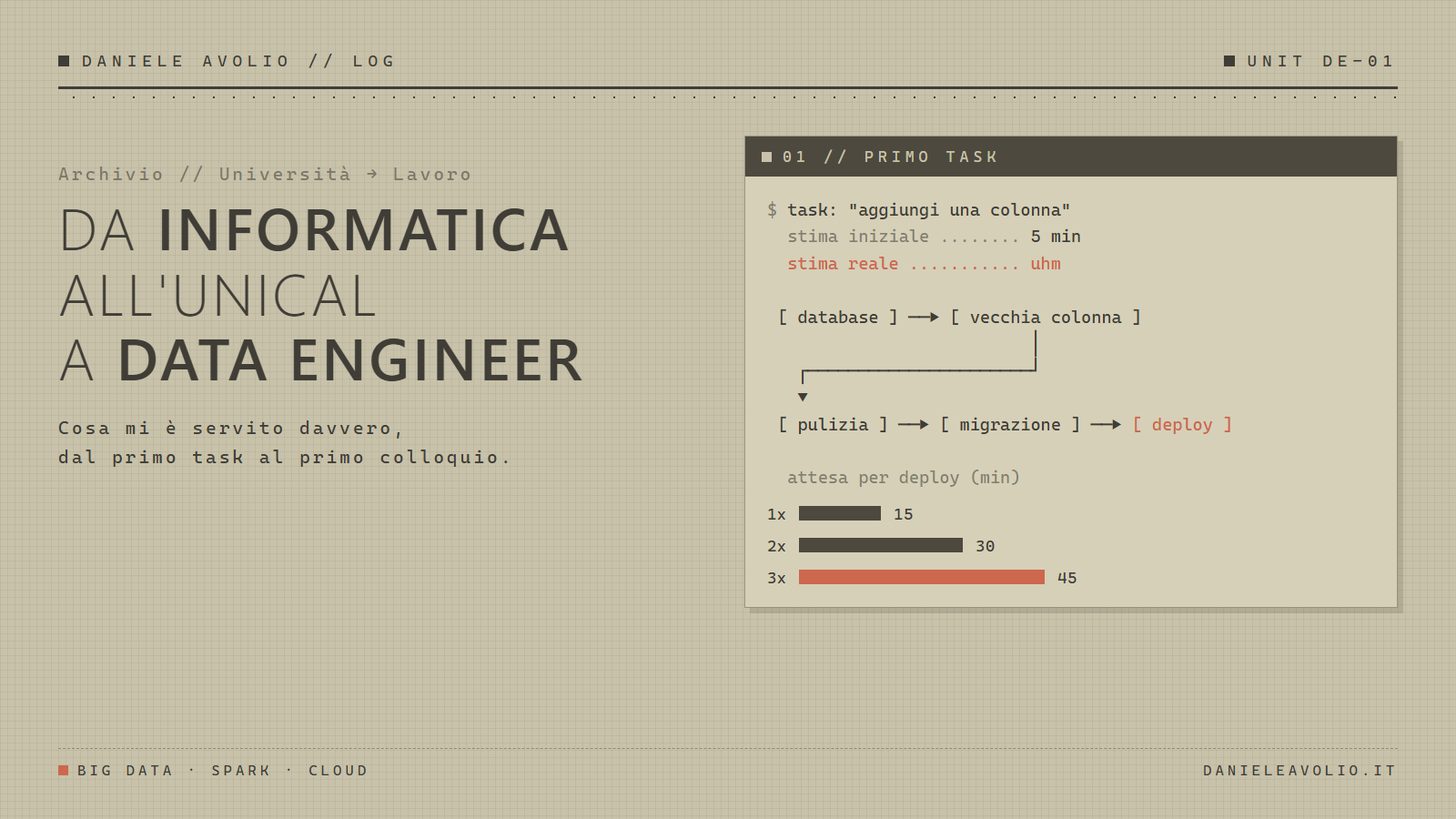
Apart from the first week at work, which was all about doing these courses, my first task was to add a column. One column. Put like that, it sounded like a five-minute job, didn’t it? Spoiler: no.
First, I had to clean up the data from the old column and migrate it to the new table. And before that, I had to figure out how the application’s database was structured, how the cloud worked and how to deploy a change. As a first task, it was about right, wasn’t it? It wasn’t impossible, but it wasn’t the sort of thing you can knock out on the fly just because you once wrote a ALTER TABLE (I didn’t like database courses at undergrad level, by the way)
The part that caught me off guard was everything I had to figure out before I could even touch the table:
flowchart LR
    A["Capire il database dell'applicativo"] --> B["Capire cosa c'era nella vecchia colonna"]
    B --> C["Pulire i dati"]
    C --> D["Migrarli nella nuova tabella"]
    D --> E["Deploy (e attesa)"]
The problem with deployments
This is where it comes in Jenkins ; you’d change just a single row and still have to wait a quarter of an hour. Run three deployments one after the other and that’s 45 minutes of pure waiting time. Even though I’m someone who always tries to optimise things, unfortunately when you can’t test locally, this is…
In my case, a single deployment took about 15 minutes. The 30 and 45 minutes are estimates for two or three deployments in sequence. The point is: even for simple things, it can take hours between testing and deployment.
How I ended up doing data engineering
When I had to choose which path to take, data engineering it seemed to me to be a field in demand and less crowded than front-end and back-end development. On the front-end side, moreover, my impression is that in many companies they’ll increasingly ask you to get involved with the back-end as well. That, however, was just my reasoning at the time. I wouldn’t base a whole career on it alone. I worked on the front end for three months and had always developed websites on my own, and I loved it. I stopped doing it when I realised it wasn’t quite what I wanted to do for the rest of my life, and having a basic understanding of where the market was heading, I decided to move into this other field.
The world cloud seemed very interesting, because they were all technologies I’d only encountered in theory at university, but had never actually worked with directly. As I’ll mention in the next paragraph, the most important exams will be those related to data, because they really made the process easier for me. It has to be said that, initially, there was a major hurdle: I hated databases during my bachelor’s degree – for a myriad of reasons, but I really hated it. I realised, however, that it’s one of the cornerstones of being a software engineer.
What I gained from Unical
As for the master’s degree, I’d say above all Big Data. You really appreciate it when you start using Spark and need to understand what’s going on behind the scenes. Knowing which command to run helps, of course, but if you don’t have a clue how the work is distributed across the machines, as soon as something goes wrong, you struggle much more to figure out where to look. I’d say theory is essential, especially in interviews for roles data , but knowing what a broadcast join is allows you to understand why the Dataproc job is failing (it’s best not to pass 100k rows to each worker, come on).
It also came in handy during my interview at Agile Lab. The selection process wasn’t exactly straightforward, but understanding Big Data concepts and already having an idea of how the cloud worked allowed me to think through the questions, rather than trying to guess the answer they were expecting. Obviously, there are plenty of other concepts to learn, such as the basics of computer science.
Other essential courses:
Fondamenti di Informatica: Professor Perri’s course was a real wake-up call, and if you were one of the three survivors out of 100 to pass the lab, you’ll know exactly what I mean. Looking back, though, I think the most useful part was actually having to think through problems for which I didn’t have a ready-made solution. What a mess…OOPandIngegneria del Software: the absolute giants you simply MUST know about.Sviluppo Web: it made me understand how Frontend and Backend work. Not the course itself – it didn’t exactly blow me away… But the project was brilliant: GameSyllabusMachine LearningandDeep Learning: I LOVED these courses, because they made me understand – properly – what this branch of computer science was all about and why it was so fascinating. The best courses I’ve ever taken. I wish I’d taken them in 2025/2026, in the hope they’d cover the latest developments in AI, LLMs and agents in more detail.
Recommended video:
Quick summary.
Exam | Where | What’s been useful for my work |
|---|---|---|
Big Data | Master’s | Understanding what Spark does behind the scenes, and the interview |
Fundamentals of Computer Science | Bachelor’s degree | Thinking through problems without a ready-made solution |
OOP and Software Engineering | Bachelor’s degree | Organising Code |
Web Development | Bachelor’s degree | Understanding what lies between the front end and the back end |
Machine Learning and Deep Learning | Master’s | How AI works behind the scenes. |
Do you need a project to land your first job?
If you already have a project, bring it along. However, I wouldn’t get too hung up on having to build a cloud pipeline before applying; you learn a lot when you start working on a system that already exists. In the interview, what matters most is how you reason your way through a problem, even a small one.
Take the case of the column. If they ask you how you’d migrate it, don’t just blurt out a solution straight away. Ask what the old column is like, what data it contains, and how you’d know if you’d lost any during the migration. From there, you’ve got something to work with. This applies just as much to an architecture question as it does to a coding challenge.
Tip: when faced with a technical question, a well-phrased clarifying question is worth more than a random answer.
A simple challenge is fine. Memorising LeetCode solutions, on the other hand, is, in my opinion, a load of rubbish. If they change a single detail of the problem, you still need to work out whether the solution you had in mind still holds up. And that’s exactly the skill you’ll need in a real job.
What I’d ask a company today
At the interview, I’d ask what projects they’re working on and what I’d actually be doing in the role I’m applying for. If they reply, “You’ll be doing data engineering”, I’d ask what someone already doing that job has been doing over the past week. That gives you a much better idea of the day-to-day work than the list of technologies in the job advert, which is often just fluff.
Then I’d ask how project changes work. When you’re looking for your first job, it seems like a question best left for later. But spending six months or a year doing something that bores you really takes its toll – and quite a lot at that. (A true story)